Knowledge Transfer and Succession Planning
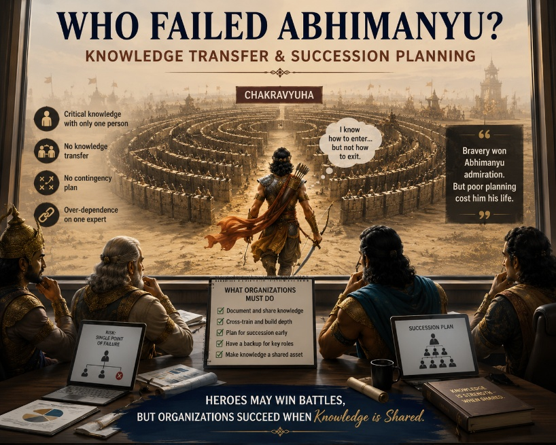
One of the most discussed episodes from the Mahabharata is the story of Abhimanyu.
A young and valiant warrior, Abhimanyu stepped forward to confront one of the most formidable battle formations ever created—the Chakravyuha. With Arjuna deliberately drawn away from the battlefield, Abhimanyu was the only Pandava warrior who knew how to enter the formation. Unfortunately, he did not know how to exit it, and despite his unmatched courage, he was eventually overwhelmed.
The story is often celebrated as the tale of an extraordinary hero who rose to the occasion.
But I often ask a different question:
Who really failed Abhimanyu?
Was it simply destiny? Or was it a failure of knowledge transfer and succession planning?
Abhimanyu possessed only partial knowledge. He entered the Chakravyuha believing others would support him. However, the remaining Pandava warriors themselves lacked the knowledge to break the formation and rescue him.
From a management perspective, this highlights several organizational failures:
- Critical knowledge was concentrated with a single individual—Arjuna.
- There was no structured knowledge transfer to the next generation.
- There was no contingency plan for Arjuna’s absence.
- The team depended heavily on one expert, creating a single point of failure.
How often do we see similar situations in our organizations?
A project manager resigns without a proper handover.
A key engineer is the only person who understands a critical system.
A senior leader retires, leaving no groomed successor.
A project suffers because documentation is incomplete and knowledge exists only in someone’s mind.
These are not people problems—they are process problems.
Organizations invest significant effort in acquiring knowledge but often overlook preserving and transferring it. Effective knowledge management, comprehensive handovers, cross-training, and succession planning are not administrative tasks—they are strategic necessities.
Had the knowledge of the Chakravyuha been shared among multiple warriors, the outcome may have been very different.
The lesson from Abhimanyu is therefore not just about bravery.
It is about ensuring that critical knowledge never resides with just one person.
If your organization’s “Arjuna” resigned tomorrow, would your “Abhimanyus” still succeed?